If you’ve spent any time dialing in screen printing setups, you already know that mesh selection can make a huge difference in print quality. One mesh that’s been standing out lately is SAATI’s Hi-Dro mesh — and after running some real-world testing with it, the results were hard to ignore.
So what actually makes Hi-Dro different?
The simple answer: it’s a thin-thread mesh.
That means the thread diameter is smaller than standard mesh, even when comparing the same mesh counts. Because the threads themselves are thinner, the open area of the mesh increases. More open area means more room for ink to pass through the screen.
And that’s where things start getting really interesting.
More Open Area = Better Ink Flow
With standard mesh, a certain amount of the screen surface is occupied by thread. When you reduce thread diameter like SAATI does with Hi-Dro, you naturally create more open space in the mesh.
That increased open area helps ink flow more efficiently during the print stroke. The screen simply becomes less restrictive.
But there’s another benefit that often gets overlooked — emulsion.
“It’s How the Noodle Holds the Sauce”
One of the ways I usually explain this to printers is:
“It’s how the noodle holds the sauce.”
Because the threads are thinner, the emulsion has more area to build into. Your EOM (Emulsion Over Mesh) increases almost inherently due to the mesh construction itself.
That higher EOM creates a better stencil gasket, which helps deliver a stronger ink deposit onto the garment. Even with a single print stroke, you can achieve a brighter, smoother, and more solid result.
For printers trying to improve opacity, smoothness, or overall print quality without adding extra strokes or slowing production down, that matters a lot.
Real-World Testing at Shirt Show Super Base Camp
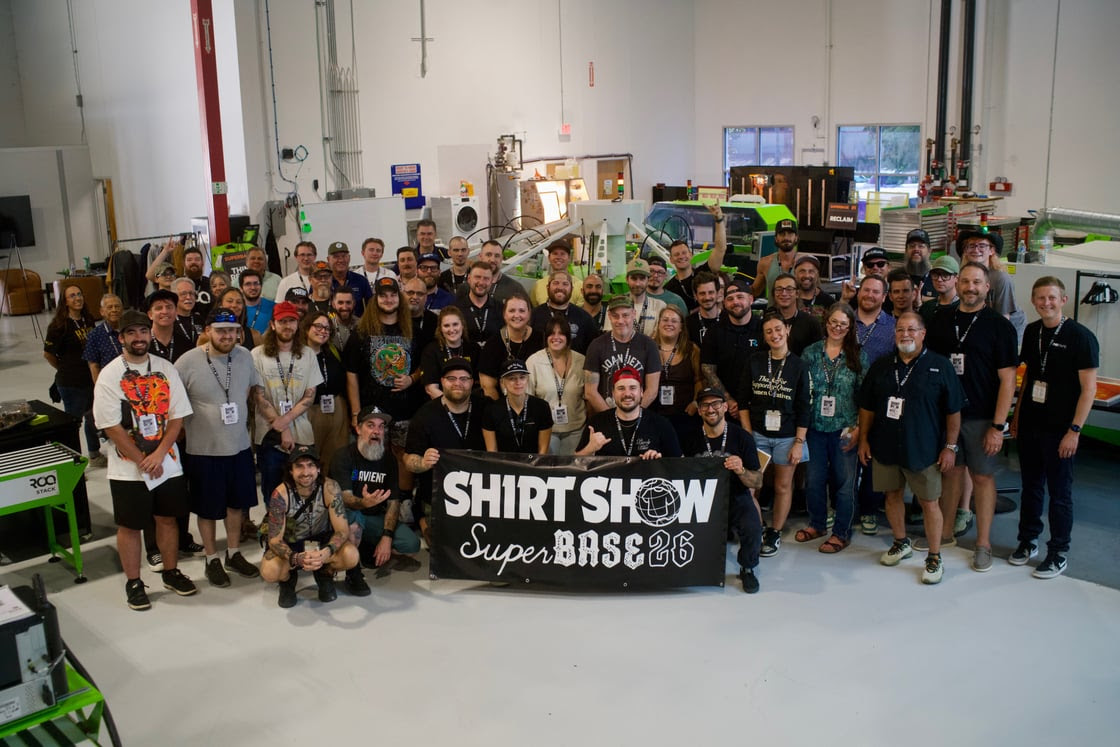
A couple weeks ago at Shirt Show Super Base Camp — held at the ROQ US facility in Clermont, Florida — we had the opportunity to run a side-by-side comparison between standard mesh and SAATI Hi-Dro.
The test was intentionally simple.
Both screens were run with identical press settings:
- 40 PSI
- 10-degree squeegee angle
- Same squeegee durometer
- Same print speed
- One print stroke only
The only difference was the mesh.
And honestly, the results spoke for themselves.
The Hi-Dro portion of the test print was noticeably brighter, smoother, and overall more desirable. The ink laydown looked more complete and uniform, even though everything else about the print setup remained unchanged.
That’s the kind of improvement printers actually care about — not theoretical gains, but visible differences on press.
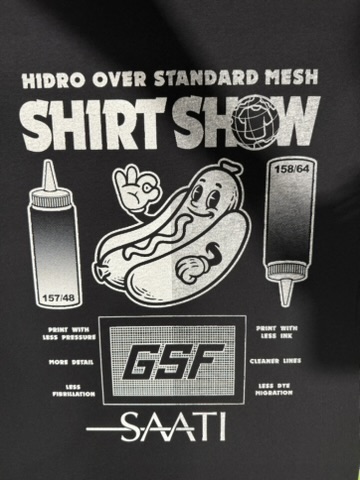
Why It Matters in Production
At the end of the day, better ink transfer can solve a lot of problems:
- Better opacity
- Smoother prints
- Stronger whites
- Improved single-stroke performance
- More consistency across runs
And because the mesh itself helps create a better stencil profile, you’re not always relying on heavier pressure or multiple strokes to get there.
For shops focused on efficiency and print quality, SAATI Hi-Dro is definitely worth testing in your own production environment.
Sometimes a small change in mesh construction can create a surprisingly big difference on press.