How to Evaluate Polyester Garments Before Decoration and Production
When it comes to decorating on polyester, dye migration is one of the most common and costly print defects. It occurs when the dyes in synthetic fabrics become reactivated under heat and migrate into the ink layer—especially whites—causing discoloration.
At MADE Lab, we conduct standardized migration testing for the industry using the AATCC Gray Scale for Staining and evaluate performance across multiple decoration methods including plastisol, waterbase, and heat press applications (DTF).
But you don’t need a lab to perform meaningful pre-production testing. If you’re printing on performance polyester, a simple in-house test can help you evaluate risk levels, make informed ink choices, and avoid failed prints.
Why Test?
Every polyester garment will bleed to some degree—the question is how much. Certain dyes are more stable, others are more reactive. Pre-testing helps you classify garments into three key performance tiers:
- Low migration risk – likely printable with standard low-bleed inks
- Moderate risk – requires testing with low-cure inks or additives
- High migration risk – requires use of a dye-blocking underbase or specialty solutions
We recently tested A4’s 5-STAR and Airflex performance polyesters and found them to perform exceptionally well, especially in the performance apparel category.

In-House Migration Test: MADE SOP Procedure
Follow this procedure to determine how a garment will respond to heat and identify its dye stability before going to press.
Required Tools & Materials
- Heat Press – Digital Temp
- Thermocouple or donut probe (Optional but optimal to verify surface temperature)
- Test garment fabric (cut 4” x 4” swatch from actual production garment)
- White fabric (cotton or Pellon non-woven interfacing)
- Plasticizer (e.g., Avient K2910 Viscosity Buster) or clear gel ink
- AATCC Gray Scale for Staining (recommended for accurate grading)
Test Procedure
1. Preheat & Calibrate
- Set the heat press to 320°F (160°C).
- Confirm actual platen surface temperature using a thermocouple or donut probe.
2. Stack Materials
- Lay the 4” x 4” garment swatch face-up on the lower platen.
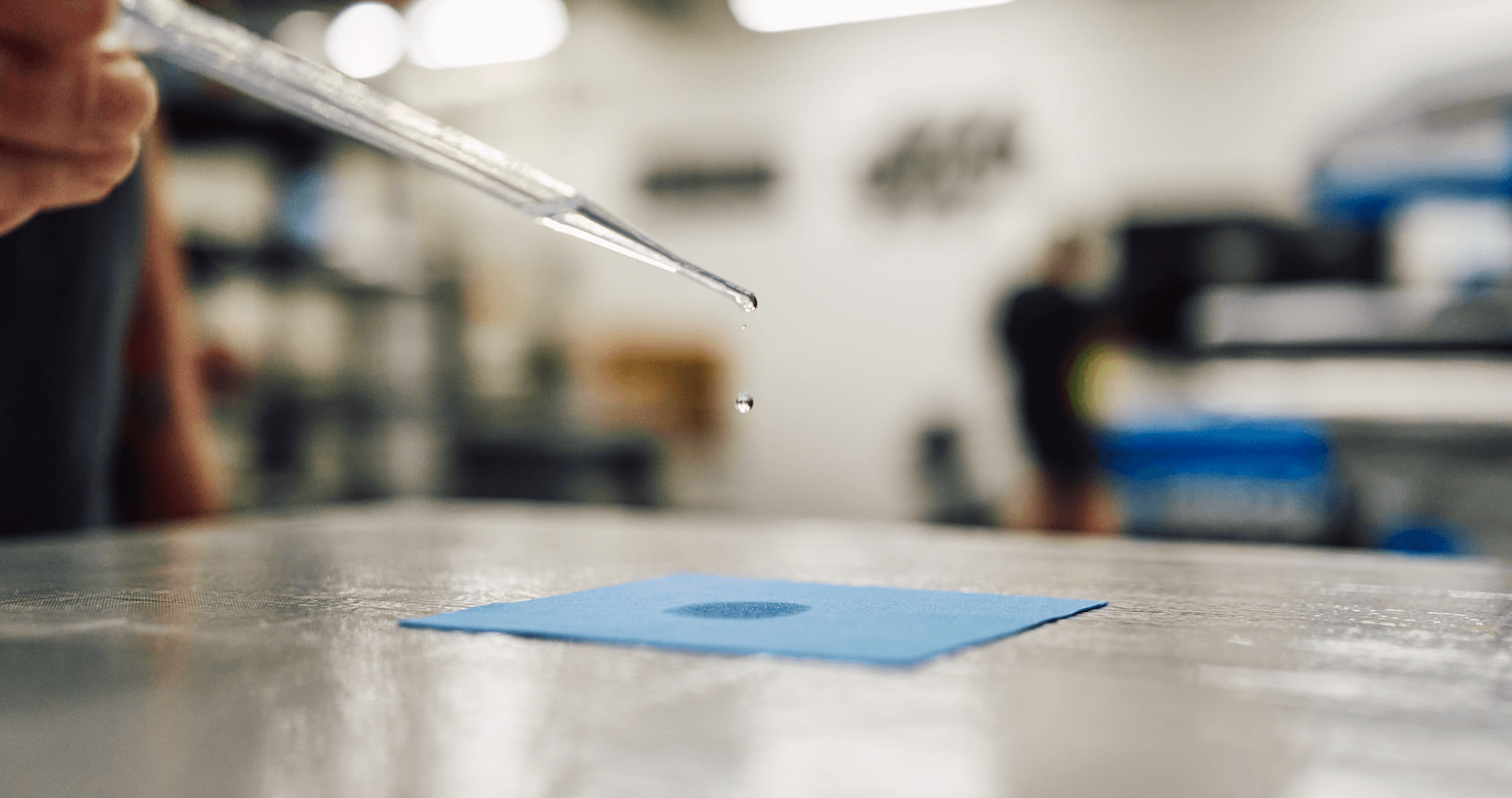
- Apply a quarter-sized amount of plasticizer or clear ink to the center of the fabric.

- Place a white cloth or Pellon square directly on top of the ink area.

3. Apply Heat
- Close the press and apply medium pressure for 30 seconds.

4. Evaluate Results
- Remove the test materials and inspect the white cloth for staining or discoloration.
- Compare results to the AATCC Gray Scale for Staining to assign a migration score.

Interpreting Results
| Gray Scale Score | Assessment | Recommended Action |
| 5 – 4 | Excellent | Low migration risk. Test with low-bleed plastisol or standard whites. |
| 3 – 3.5 | Moderate | Use low-bleed inks; confirm with full ink test. Monitor production. |
| 2.5 or lower | High Risk | Use dye-blocker underbase and/or low-cure inks. Test entire design before production. |
Note: Lower-rated garments will increase your cost of decoration—due to added consumables, print steps, and ink systems.

Summary
This test provides a reliable method to identify dye migration risk and make better-informed decisions about:
- Ink selection (standard vs. low-bleed)
- Underbase requirements (with or without blocker)
- Cure temperature and dwell time adjustments
- Suitability of the garment for specific decoration methods
For high-volume production or high-value garments, we recommend running a full suite of tests including full production test, aging in heat, and washing—or sending samples to MADE Lab for comprehensive evaluation under our standard testing protocol.