
If you’ve been in this industry long enough, you’ve probably said some version of:
“Yeah, we stay busy.”
Or… “It depends.”
Or the classic… “It feels like we’re burning through screens lately.”
The problem? Feels like isn’t a strategy.
If you actually want to scale your shop — not just survive week to week — you need data. And the simplest way to get it? Start writing things down.
Documentation = Clarity
Documentation sounds corporate and boring, but in a print shop it’s just this:
- How many screens did we use this week?
- How many per day?
- What was our average order quantity?
- How long did an average job take from art approval to boxed and out the door?
- How many re-burns did we have?
- How many rush orders?
- How many setups per day?
When you track these consistently, patterns start to show up.
And patterns are where smart decisions come from.
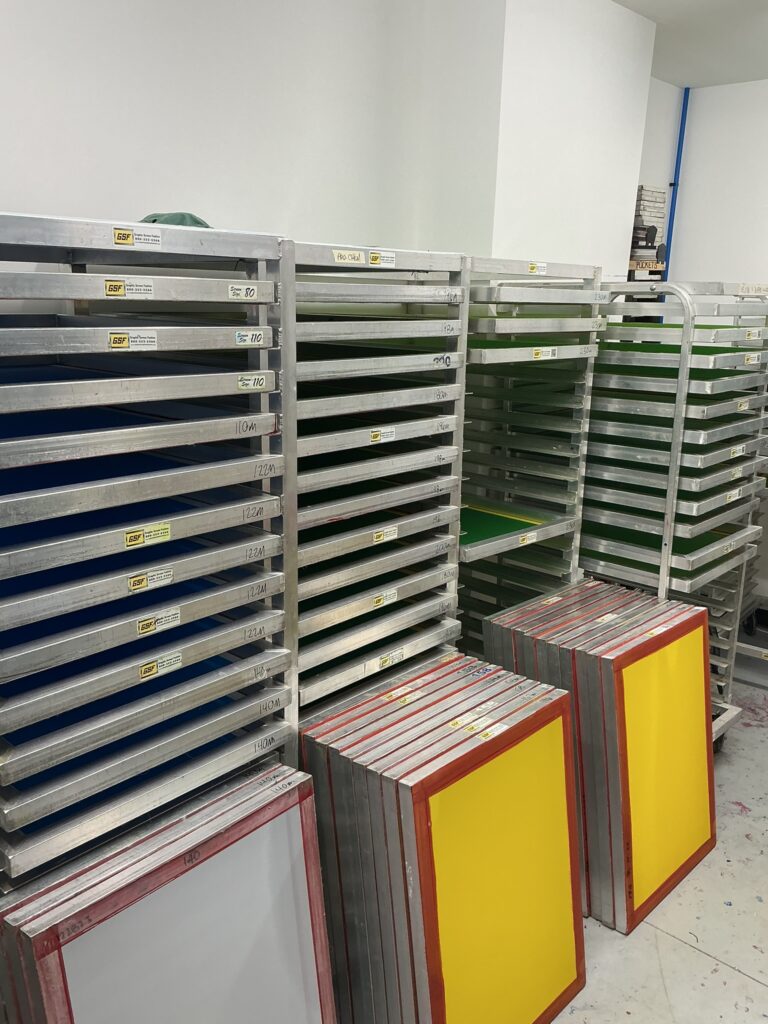
Screens Don’t Lie
Let’s say you start tracking screen usage.
At first it’s just a number on a whiteboard or in a spreadsheet. But after a few months, you might realize:
- You’re averaging 220 screens per week.
- Mondays and Tuesdays are heavy burn days.
- You’re consistently short on two specific mesh counts.
- You’re re-burning 8–10% of screens due to art or exposure issues.
Now you’re not guessing anymore.
You can:
- Adjust purchasing before you run out.
- Justify new equipment.
- Tighten up art approvals.
- Schedule reclaim more efficiently.
- Plan staffing around actual workload instead of vibes.
That’s scaling with intention.
Average Order Quantity Tells a Bigger Story
Tracking average order size is huge.
If your average order is 24 pieces, that’s a different business than if your average is 144. Your equipment, staffing, pricing structure, and workflow should reflect that reality.
Let’s say you calculate:
- Average order size: 36 pieces
- Average production time per job: 1.75 hours
- Average setups per day: 6
Now you can ask smarter questions:
- Are we pricing correctly for small-batch work?
- Are we wasting too much time on changeovers?
- Would a second press actually increase throughput — or just increase overhead?
Without documentation, those are guesses. With documentation, they’re measurable decisions.
Trends > Snapshots
One busy week doesn’t mean you’ve outgrown your shop.
One slow month doesn’t mean you’re failing.
Documentation lets you zoom out.
Over time you’ll see:
- Seasonal fluctuations
- Repeat customer patterns
- Growth trends
- Production bottlenecks
- Equipment strain
- Labor inefficiencies
Instead of reacting emotionally to every spike or dip, you respond strategically.
It Builds Confidence
Scaling is scary when you’re guessing.
Hiring a new printer.
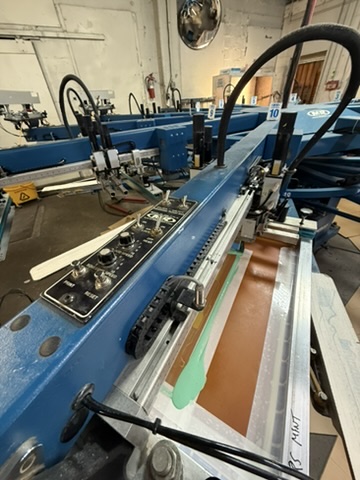
Buying another auto.
Moving into a bigger space.
Adding embroidery.
Investing in better exposure.
Those moves feel risky when you don’t have numbers to back them up.
But when you can say:
- “We’ve increased screen usage 18% year-over-year.”
- “Our average turnaround time is slipping because setups have increased 30%.”
- “We’re consistently hitting max capacity three days a week.”
That’s not a gamble anymore. That’s an informed decision.
Start Simple
You don’t need fancy software on day one.
Start with:
- Screens burned per day
- Impressions completed per day
- Average order quantity
- Production hours per job
Track it consistently. Review it weekly. Talk about it with your team.
Over time, you’ll naturally expand what you track — reclaim cycles, spoilage, press downtime, ink usage, labor hours per department.
Documentation becomes less about paperwork and more about control.
The Real Benefit
Writing everything down forces you to look at your shop objectively.
It shifts you from:
- “We’re slammed.”
to - “We’re running 92% capacity.”
From:
- “We’re wasting time somewhere.”
to - “Our average changeover is 22 minutes. We can improve that.”
That clarity is what allows you to scale with confidence instead of chaos.
Because growth without documentation just creates bigger problems.
Growth with documentation builds a stronger shop.
And if you’re serious about scaling, stronger is the goal.